Why do people givecarnations on May 9th
May 9 is approaching — the most solemn, sincere and touching holiday. This is a day we truly greet "with tears in our eyes." After all, there are fewer and fewer veterans every year — the people to whom we owe the Great Victory, peace, and life itself. In 2022, there were 387 of them left in Kazakhstan.
The more we want to express our gratitude, love and pride in their feat. And for this, we have grown accustomed to giving carnations on Victory Day. We also lay them at the Eternal Flame and other memorials as a tribute to the fallen. But how many know why these particular flowers became a sign of soldiers' courage and heroism? Does this beautiful tradition have a history? We'll tell you.
Why is the red carnation a symbol of victory?
This interpretation doesn't seem strange to us: everyone is used to seeing red carnations in the hands of veterans, at monuments and on Victory Day cards. But in the Middle Ages (and even today in the Western Christian tradition), this flower was considered a symbol of betrothal, the Mother of God's maternal love for her son Jesus, and Christ's sacrificial blood. That is, there was nothing heroic or warlike about it.
The fragile plant acquired a new meaning in France, where after the victory of the French Revolution, the defeated royalists chose it as their symbol. They took scarlet buds with them as they ascended the scaffold, emphasizing their sacrifice and courage.
And girls from the common people, on the contrary, considered this flower a talisman in battle. They gave it to their fiancés and husbands going off to war, with wishes to win and return alive. Every French soldier kept such a gift as a talisman. Even Napoleon Bonaparte believed in its protective power. When establishing the Legion of Honor, he chose the color of the red carnation for the order's ribbon.
Russian revolutionaries also liked this emblem. After 1917, the carnation became an indispensable attribute of all Soviet celebrations, award ceremonies, badges and cards.
Its meaning as a symbol of struggle and courage grew noticeably stronger during the Great Patriotic War. Of course, heroes were welcomed home with whatever flowers were at hand. But over time, giving veterans specifically red carnations became an unchanging tradition.
How many carnations to give on May 9
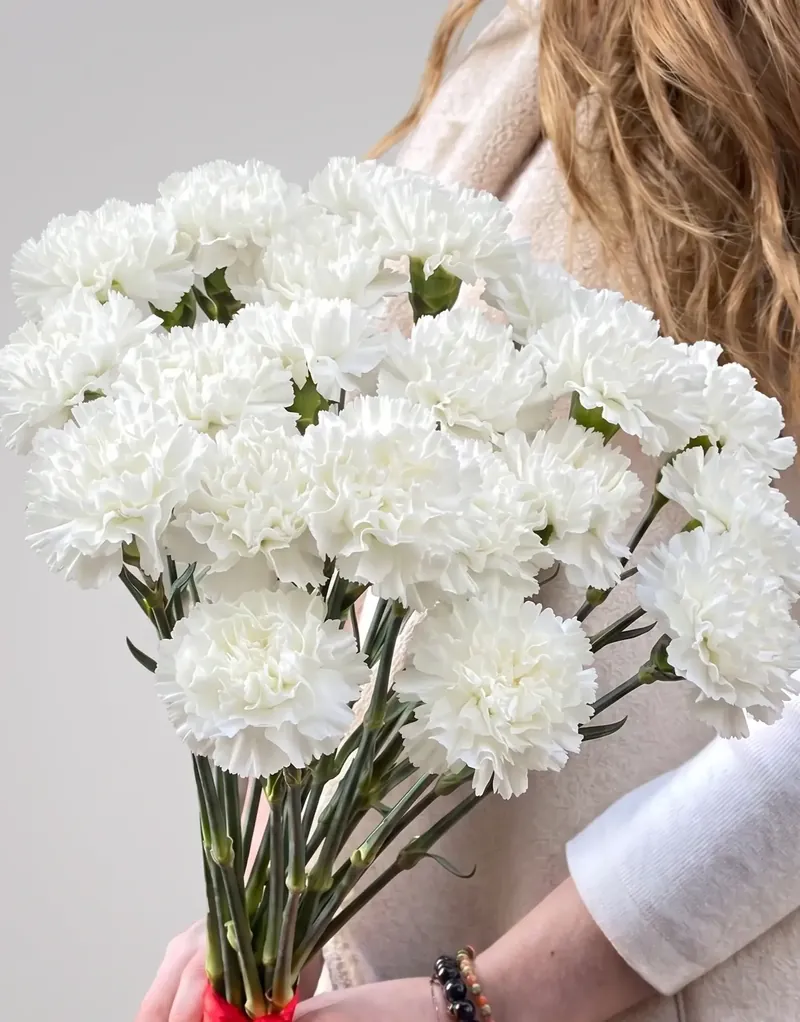
At the festive procession, or when honoring veterans at school or another institution, usually 3–5 flowers are given. If you want to make the gift more personal, to give a bouquet from yourself or your family — it's better to buy 7–9 carnations.
Elaborate bouquets with lush decor are inappropriate on such a day, and indeed for elderly people in general.
A armful of flowers can be laid at a memorial in memory of the fallen heroes. But it's better to choose a neat basket — it's more beautiful and longer-lasting.
How else to congratulate veterans
As for our veterans, they don't need luxurious compositions of dozens of flowers. What matters far more is showing care and attention. Visit veterans you know or don't know together with your children, offer help, listen to their stories. Let your attention and care be not symbolic, but quite tangible and real.
Carnations for May 9 — are merely a way to say that we remember their feat and the courage they showed, the blood shed by their comrades who are no longer with us.