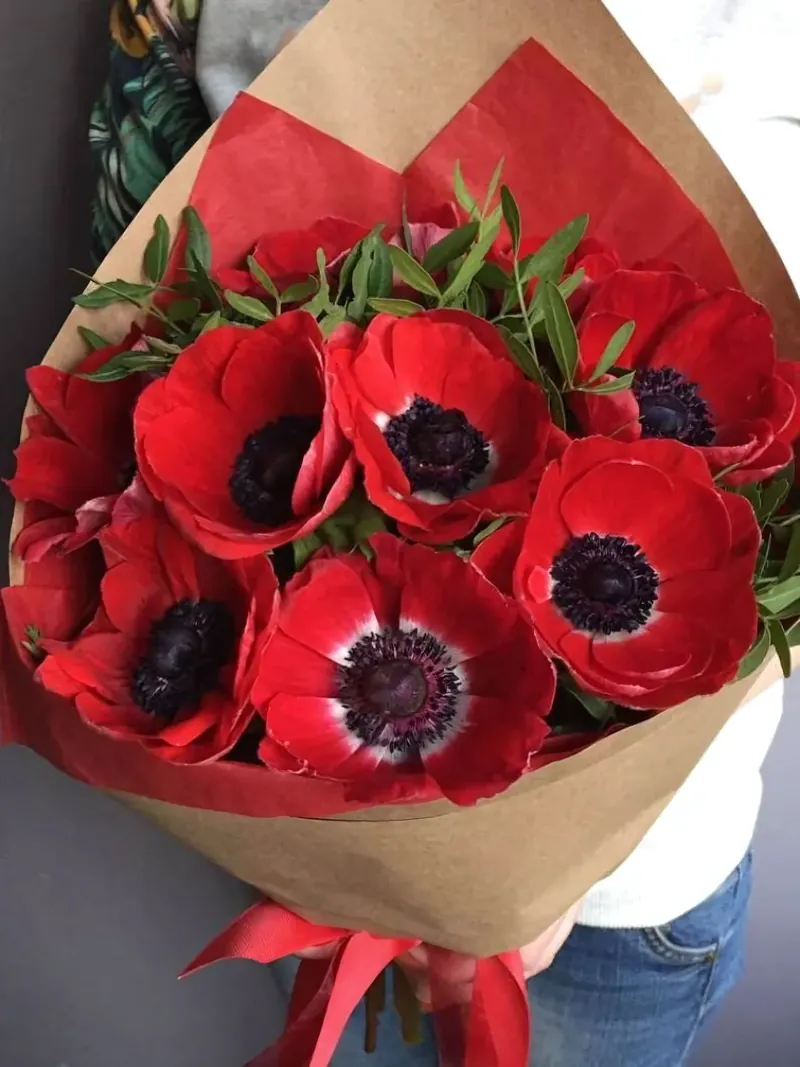
Red anemones
Anemone — 9 pcs, greenery
Anemone — 9 pcs, greenery
Hydrangea — 1 pcs, anemone — 2 pcs, anthurium — 1 pcs, rose — 4 pcs, tweedia — 2 pcs, lisianthus — 2 pcs, eucalyptus, bush rose Juliet — 3 pcs
Anemone — 16 pcs, dried flowers — 1 pcs
Anemones in Almaty from Pro-Buket are bouquets arranged by our florists in the salon and delivered by Pro-Buket couriers at the exact time, including nighttime and anonymous orders. Before dispatch we send a photo of the bouquet, and delivery costs by zone start at 2,500 ₸, with free pickup. We are not an aggregator: we arrange and deliver the bouquets ourselves.
The price of a composition is made up of several clear parameters — the number of blooms, the shade and variety, whether it is a mono-bouquet or a mixed one, the companion flowers and the styling, the season and holiday demand. Let's go through each.
The cost depends first and foremost on the number of blooms: the more stems in the composition, the higher the price. Shade and variety are a separate variable: white and soft pink varieties are more consistently supplied on the Almaty market than deep burgundy and blue, which arrive less often and in smaller batches. The final sum is influenced most not by the flower itself but by the styling and companion flowers — switching from film to a box and adding ranunculus changes the price more noticeably than changing the shade, so it makes more sense to compare items by their composition rather than by name.
Before you buy anemones in Almaty, look at the price and composition in the catalog listing: Pro-Buket shows the cost of each item before you place an order. The listing shows the number of stems, the anemone variety, the type of packaging and the companion flowers — that is enough to compare items with each other and understand exactly what you are paying for. The salon florist does the arranging: they trim the stems at an angle, place the flowers in a nutrient solution, check the firmness of the bud and wrap the bouquet for the chosen occasion. The season and holiday demand before March 8 push the price of cut flowers up, so it is worth reserving an item from the catalog in advance rather than on the last day — that way the choice of shades and styling is wider.
The anemone is a seasonal cut flower, and it is normal that in some months the choice is wider and in others narrower. Here is how the season works and what to do if the shade you want is not available right now.
Cut anemones in Almaty are a seasonal flower: mass cutting runs from autumn to spring, peaking in winter and early spring, and during those months the choice of shades is at its widest. In November–March, white, red, pink, purple and blue varieties bloom simultaneously on plantations in Ecuador, Kenya and Israel — from the classic "De Caen" to the double-flowered "Mistral" and "Bordeaux". In summer they appear in bouquets less often and cost more because of the heat and logistics: a stem at +35 °C loses its turgor in 12-18 hours, so if you specifically want this item in the warm season, it is wiser to check availability in advance rather than count on a spontaneous purchase.
If the shade you want is not available right now, the Pro-Buket florist will suggest a close substitute in tone or arrange a bouquet with flowers of a different color in a similar palette. In our practice, the most common substitution is burgundy "Bordeaux" for a rich purple or wine shade — in an arrangement with eustoma and eucalyptus, only a florist can tell the difference. A similar story with blue: if the "Blue" line is gone, it is covered by lilac "Sylphide" paired with white gypsophila. Substitutions are worth discussing before arranging, not after: the florist can see which shades work together in one palette and can arrange the composition so that the swap goes unnoticed by the recipient.
Anemones seem finicky only at first glance: the buds close at night, the stems reach toward the light, and the flower drinks a lot. Let's break down what's normal here and what's a genuine sign of staleness.
An anemone opens in light and warmth, and at night and in cool air it closes its petals — this is the flower's physiology, not a sign of wilting. In the morning, at a room temperature of +20…+22 °C, the bud opens within 40-60 minutes, while in a hallway by the front door, where it's usually 3-4 degrees cooler, it stays half-closed until noon. The stem keeps growing even after cutting — in a vase it stretches by 1-2 cm per day and turns toward the window, so by the third day the bouquet noticeably changes its silhouette. In a vase the flower bends its stems toward the light source, so turn the vase 180 degrees every morning if you want to keep the arrangement straight, and keep it away from direct sun, a radiator, and an air conditioner — temperature swings speed up opening and shorten the vase life by 2-3 days.
Flowers are delivered by the salons' own couriers — by zone with clear rates, at an exact time, including night and anonymous orders. Below is how the process works from address to handover.
| Zone | Delivery cost |
|---|---|
| Pickup | 0 ₸ |
| Zone 1 | 2,500 ₸ |
| Zone 2 | 3,000 ₸ |
| Zone 3 | 4,000 ₸ |
| Zone 4 | 6,000 ₸ |
Anemones with delivery in Almaty cost different amounts depending on the zone: pickup is free, courier delivery is from 2,500 ₸ to 6,000 ₸. Zone 1 covers the center — Almaly and Medeu districts, Zone 2 — Bostandyk and Auezov, Zone 3 — Nauryzbai and Zhetysu, Zone 4 — the outskirts and microdistricts like Shanyrak and Alatau. The rate depends only on the recipient's address, not on the size of the bouquet or the time of the order. Our pickup from the salon is free, so when your schedule is tight it's sometimes more economical to pick up the bouquet yourself on the way.
Flowers are delivered at an exact time: orders are accepted daily, 9:00–24:00, night delivery is arranged by prior agreement, and with an anonymous order the recipient doesn't learn the sender's name. The courier arrives within the chosen interval, not "sometime during the day" — for a gift to a colleague by 2:00 p.m. or a surprise for dinner at 7:30 p.m., that makes all the difference. We follow the same protocol: the window is agreed in advance, and the courier confirms departure with a call. A card comes free with the bouquet — for anonymous delivery, it's best to write the text without a signature or recognizable details like "from your classmate," otherwise the surprise will be revealed before the handover.
A Pro-Buket courier delivers anemones to the suburbs of Almaty, and if the recipient isn't home, waits on the spot for 15 minutes, then calls the sender. With the sender's consent, the bouquet is left at the front desk or in a nearby shop; if it can't be left, it returns to the salon — a repeat delivery is paid for again, or the bouquet can be picked up free of charge, and the money is not refunded. In frost and heat, choose a delivery window so the bouquet doesn't sit outside for long: delicate flowers lose turgor within 40-60 minutes in the heat, and in frost below −5 °C the petals darken within just 10 minutes. In winter, ask the courier to take the bouquet straight into the entryway or office rather than leaving it in the car until the recipient answers.
These flowers are often confused: the buds look similar in shape, but they behave differently. Let's break down the differences by center, stem, and how they open in a vase.
| Feature | Anemone | Ranunculus | Poppy |
|---|---|---|---|
| Center | dark, pronounced | no dark center | dark, small |
| Bud | single, half-open | multi-layered, double | "drooping," loose |
| Petals | thin, silky | dense, "rose-like" | like crepe paper |
| Stem | sturdy, green | sturdy, green | fuzzy, with milky sap |
| In a vase | opens and closes | holds its shape | sheds quickly |
If you're unsure when ordering, go by how they behave in a vase: the anemone opens and closes, the ranunculus holds its shape, and the poppy sheds quickly — this is more reliable than comparing photos.
When ordering, the easiest thing to go by is the center and the shape of the bud: the anemone has a visible dark center and a single half-open bud, while the ranunculus has a dense, multi-layered ball. The second marker is the stem: the poppy's is fuzzy and releases milky sap, which is why in mixed bouquets the poppy is placed separately from delicate spring flowers. The anemone's stem is smooth and sturdy, holding the bud upright even in a short vase. We list the composition of each item with anemones in the catalog card, so anemones and ranunculus are distinguishable by the list of flowers. In our practice, the most common mix-up is ordering a "spring bouquet" without specifying the composition: before placing your order, check the list of items, or you may get ranunculus instead of anemones.
The shade and number of blooms suggest what occasion a bouquet is suited for. Let's break down the symbolism of shades, the appropriate number of anemones, and combinations in mixed arrangements.
By common practice, an odd number is given — 5, 9, or 15; for March 8 and birthdays, 9–15 are appropriate, while for a date, 5–7 is enough. For mixed bouquets, florists use ranunculus, tulips, mimosa, hyacinths, and eucalyptus — these companions hold their shape next to the thin stem. In a mono-bouquet, 9–11 blooms of a single shade are enough: a dense arrangement keeps the buds from opening unevenly. Our florist assembles mixed arrangements and selects companions to suit the occasion, and before sending, shows a photo of the finished work. If the order is for a specific time, add no more than two types of greenery to 15 blooms — extra stems weigh down the structure and shorten the time until the first trim.
Here's the main thing to keep in mind before ordering anemones — from price and season to checking freshness and delivery details by district of Almaty.
Message the florist: we’ll pick flowers, colour and quantity for your budget and send a photo before dispatch.
We usually reply within minutesBuy in one click
Enter the full number
A manager will call you back to confirm the address and time
Delivery city: Almaty?